
Huginn and Muninn

There is a weathered green bench on the strip of sunblasted grass between the street and the sidewalk. Odin sits there, drapes his suit jacket over the back of the bench, and looks at what’s for lunch.

Times were, whole roast boar, pheasants, flagons of wine and ale.

Not to mention the wenches.

Odin sighs and peels the plastic cover off a serving of Greek salad from the deli. He spears a cherry tomato with a plastic fork.

Times were.

A grey crow hops up.

No, wait, it’s a black crow. A grey crow yawked at him a few minutes ago when he was walking here from the deli. He used to always have to stop and think, which one is Huginn and which one is Muninn? Which is the grey one and which is the black one? Then he decided, I am Odin, I say the first one you see is Huginn and the other one is Muninn, just because. So the grey one from before was Huginn — Odin gave it a handful of peanuts — which makes this black one Muninn. Careful not to spook Muninn, Odin tosses a few peanuts in its direction.

Which Muninn eats.

“How are you with dairy?” asks Odin, and tosses over a piece of feta cheese. Muninn looks at the cheese, thinks about it, then hides it under a pile of dead leaves in the gutter.

Eating peanuts and salad is nice when you’re hungry, thinks Odin, but sharing them with hungry crows is even better.

“Have you lore for me, Muninn?” asks Odin. “What say the slain?”

Muninn is seeing how many peanuts it can carry in its beak, and so says nothing.

Time was, thinks Odin, and polishes off his salad, even the last hard-to-get bits of grated carrot.

The god of the office and the god of the streetcar

The god of the office is headed somewhere to learn something and gets on a streetcar to take him to the subway, but it is a different streetcar and turns left where the streetcar he wanted would have gone straight, but he looks at the chart showing the streetcar’s route and it will take him to an even better subway station so he decides to stay put and enjoy the ride.

There is a puddle of something under a seat two rows up, that is why the god of the office is sitting in the back row. He is quickly thankful for what looks like a puddle of piss because a few rows up, closer to where he would otherwise have sat, the god of the streetcar is saying something in a loud voice. The god of the office leans over for a better look. The god of the streetcar is in his thirties or maybe late twenties, pig shave, wife-beater shirt, random tattoos, large can of beer, open, despite the fact that it is just after nine in the morning.

And what a glorious morning it is! Vienna never looked this nice. Or, this section of Vienna, which the god of the office has never before seen, has never looked this good to him.

A woman wearing a head scarf gets off the street car and that is the god of the street car’s cue to give his opinion of foreigners, who are stealing jobs from Austrians, and apartments, and although they cannot speak German can somehow communicate well enough when they want to to take advantage of welfare and social services. There are some, in the past, and maybe even present, who would say kill the foreigners, but the god of the street car would not kill them, because he is a Mensch – he would just send them home, every last one of them.

The god of the office, who is himself a foreigner, imagines someone speaking up to the god of the streetcar and getting knifed.

The god of the office notes that no one is seated within three rows of the god of the subway. He looks out the window, where there is a park with large cages inside which boys play soccer. The god of the office is careful to keep his feet well away from the puddle of piss, which migrates slowly here and there as the street car accelerates, or slows, or goes around corners.

The god of the office first wants to tune out the other man’s ranting, but decides to listen closely instead. Because, crazy thing: who knows what something is good for? The universe has funny ways of communicating with us.

The god of the street car says his grandfather said, and he agrees, that politicians should be sewn up in a large sack and beaten with a baseball bat because they are nothing but lackeys of the rich and powerful.

The god of the office raises his eyebrows. When did the god of the street car’s rant take this tack? He does not condone violence such as that detailed by the god of the street car, but otherwise this could be something he has preached to his daughters in the car on the way to town.

Servants of bankers and high finance. The curse of materialism.

The god of the street car is channeling the god of the office!

That is me, thinks the god of the office. Never shall I rant again, for evermore.

Thanks, universe, he says out loud.

The coolest thing I’ve done since 1988

Natali, Laurent, and Agnes

Natali, Laurent, and Agnes

(I also gush a little about wet plate collodion here on medium.com.)

Vienna photographer Agnes Prammer uses a variety of technologies, including wet plate collodion. I wrote about meeting Agnes last October. Since then I have been bugging her to give a workshop.

Last weekend she did and I signed up and the universe did not smite me and I went and this is the story.

Wet plate collodion photography, executive summary: coolest photographic technology ever.

How it is done: collodion solution poured over metal or glass plate to form thin layer. When it gets a little tacky, but not dry, it is put in a silver nitrate bath. This gives you a light-sensitive emulsion. The plate goes into a plate holder, that goes into the camera, the lens cap is removed (there is no shutter), the plate is exposed, the lens cap is replaced, the plate holder is taken to the darkroom, where developer is poured over it, (these steps must all be completed before the plate dries out, hence the name) then once it develops washed off with water to stop the process, then put into the fixative solution, then a water bath, and you’re done.

It’s that simple.

The first day was devoted to technical and theoretical stuff, the second day we went outside to a park by the Alte Donau and took pictures.

I won’t go into the technical and theoretical angle here, it’s all available online if you’re interested, although it is very useful to hear face to face in a workshop. A couple of interesting facts, though: it dates back to the 1850s; collodion contains ether, that explosively flammable party drug of the 19th century; fixative solution sometimes contains cyanide (which we did not use thank god).

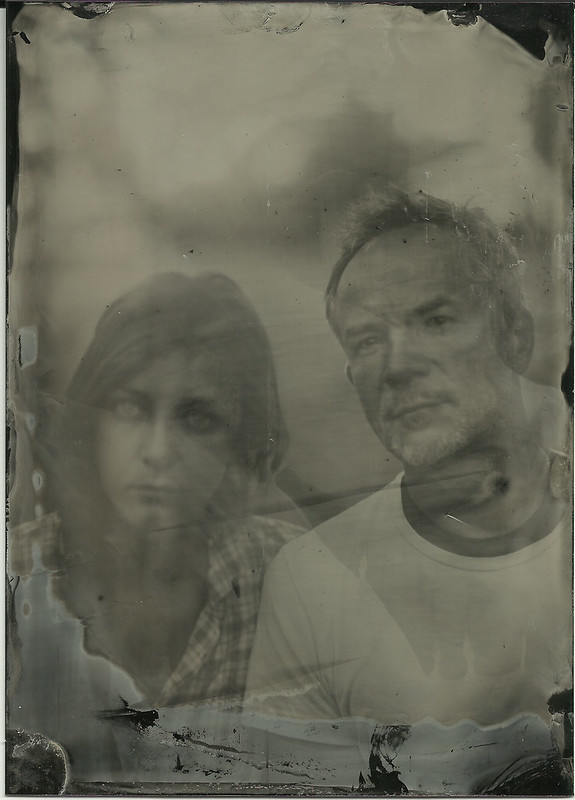
The image at the top of this post is my first attempt at wet plate photography. It shows the other participants, left to right: Agnes’s assistant Natali, Laurent, and Agnes.

Look at that picture. Don’t you just want to give them a hug? I sure did, when I walked into the studio where they were sitting around the table talking about ether and cyanide, but acting like Lennie Small is a bad idea in the first impressions department so I held myself back.
My second plate

Natali and Laurent

Weather was changeable. Mostly cloudy, a little windier than necessary, the second day. We shot in a park near the Alte Donau, water off the Danube by the Vienna International Centre where there are a lot of parks, boats, swimming, etc. We started off by mixing developer and for some reason no police showed up to ask what we were up to, sitting around a picnic table with our chemicals and rubber gloves like an early episode of Breaking Bad.

Then we took pictures with Agnes’s antique camera and developed the plates in her portable darkroom, which she made from a baby carriage. The camera, enormous, with a black cloth you put over your head to see the frosted glass plate when you compose and focus the picture, is a great ice breaker. Quite a few people stop to ask questions.
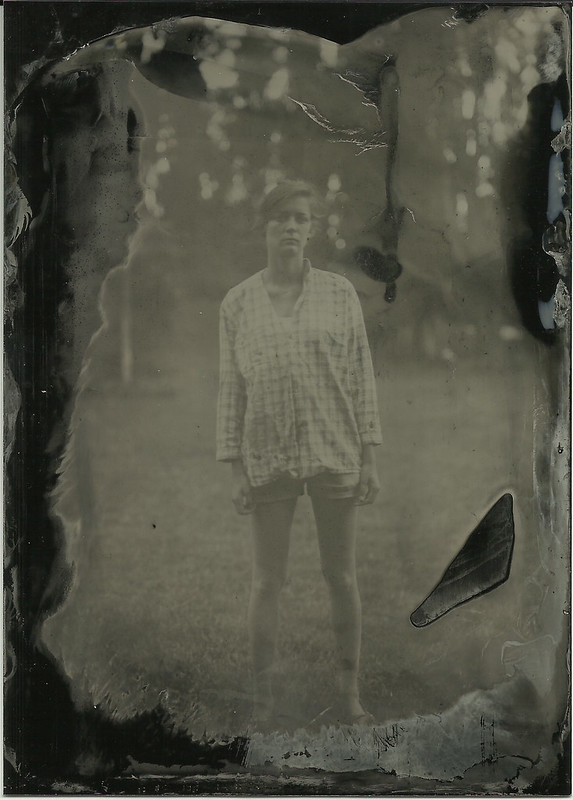
Natali

Natali

Wet plate collodion photography is a slow, fussy process. At the fastest, you can get a plate prepared, shot and developed in about fifteen minutes. I got three made all day, and they all are ruined by a variety of technical mistakes I made – pouring the collodion wrong, poor composition, poor focusing, pouring developer wrong, developing for too long, overexposure, light leaks in the darkroom, and a number of other things.

All the same, they are the best photos I have ever taken. Wet plate photography is my new favorite art form. Even in my inexperienced hands, it captures something magical and wonderful about humans that other forms of photography miss – and you should really go look at Agnes’s website to see what a talented photographer can do with it.

When I got home Saturday night, I went for a walk along the creek with my wife and gushed about the workshop and the people I had met.

“It was the coolest thing I have done since I took a pee with Boris Yeltsin at the Moscow airport men’s room in 1988,” I said.

“That’s what you said after you did your public performance of your composition for theremin, soprano and cash register a few years ago,” she said.

“I think this was even cooler,” I said.

Then something else happened. It got dark and the world came out and I saw it all — everything I looked at I saw: green fields of wheat white in the dark, the moon reflecting in the creek, the black shrubs and blacker path. The church steeple and the wino sitting at a picnic table under the half dead wild cherry tree and the bugs swarming the floodlights of the tennis club.

I saw it all with new eyes, thanks to doing something new, I guess.

Careers in Science: Deontology

The deontologist looks at the cat that woke him up. How can such a young cat be so huge, he wonders. The other day the deontologist opened the back window so the cat could climb in and he (the cat) fell off the fence before he reached the window, he is so fat. Not fat, exactly, though, just… huge.

The deontologist feeds all three cats and enjoys the few minutes during which huge cat is distracted by food and not walking figure eights around the deontologist’s feet. The deontologist thinks about everything he wants to do that morning: practice cello for half an hour in the cellar, meditate, do yoga, water things in the garden, feed the tortoise, and a number of other things.

His wife and kid are sick, though, so he postpones his new regimen of morning cello practice until the weekend.

He does the other stuff, though. And push-ups. See, the deontologist saw a website where a young woman describes teaching herself to dance in a year, by means of obsessive practice. The deontologist is all fired up.

Outside it is cool and looks as if it might rain, or might not. He puts two sections of the wooden fence his daughter is painting onto sawhorses in the back yard, as they are too heavy/bulky for her to move around.

The plum tree is heavy with green plums. The pie cherry tree is full of ripe pie cherries and blackbirds. The apple tree is full of green apples. The row of strawberries is over, but there will be raspberries all summer, and the grape vine is heavy with green grapes.

The deontologist checks on the vegetable garden at the rear of his abundant back yard. There is a big green zucchini hidden among the weeds, and a couple yellow zucchini. There are two big cucumbers ready to go. His vegetable garden is, at this time of the summer, most abundant in zucchini, mosquitos and slugs. He considers whether zucchini are the slugs of the vegetable world.

The slug traps are full of dead slugs, dozens of them, all drowned humanely in beer.

He spies a few ripe cherry tomatoes and plum tomatoes. The big beefsteak tomatoes are starting to change color. But tomato and cucumber season won’t really get going for another week or two.

At lunch, the deontologist walks to the noodle shop and buys a takeout thing of chicken and rice. He walks around and finds a bench under a tree where he had shared a sandwich with two crows earlier in the week.

Two minutes later, the crows are back. The same two crows – a large, grey-black one and a slightly smaller black one. The larger one seems more intelligent because it is more cautious. It won’t come any closer than two or three meters. The smaller one comes up within five feet of him. The deontologist throws them a couple pieces of chicken after making sure it is not too hot.

Crows are always so surprised when he is nice to them!

The crows move away when cars drive by, but come right back. They leave for longer when someone walks past with a dog.

The deontologist wonders if there are hygiene rules against sharing your lunch with crows inside the city limits.

He throws a little rice into the gutter for grey crow, but it lands too close. The deontologist moves a couple steps away so the crow can eat the rice.

There are laws against feeding pigeons, he knows. Pigeons are degenerate birds, rats with wings, but certain people get a kick out of them.

The deontologist prefers ravens and crows.

If there were coyotes in Vienna, he’d feed those too.

But there are no coyotes in Vienna.

Careers in Science: Dysteleology

The dysteleologist stands there on the sidewalk, sharing his peanuts with two crows. It turns out crows like honey-roasted peanuts.

The dysteleologist thinks, the chances of crows taking over someday are slim, but if they do, I’ll be in good shape (he shares his sandwiches with them too, in part for this reason and in part because he enjoys their surprised expressions when someone is kind to them).

The dysteleologist has a house and in a rear corner of the yard stands a shed and the neighbor ambushed his wife the other day to complain that the shed was diverting rainwater onto his, the neighbor’s, house and making the walls damp. The dysteleologist does not know if this is true or if the neighbor’s house is just damp because it is a rickety piece of shit, but he resolves to take a look at the situation on the weekend and tear down the shed if necessary, if a gutter won’t fix things. He took a walk through the yard this morning and looked at things and was slightly appalled at the hillbilly look his yard had to it and thought he would have to get this all cleaned up before the neighbor got someone from town hall over to inspect things, because really.

The dysteleologist regrets that he is not wealthy enough to move somewhere without neighbors.

The dysteleologist had a talk with his daughter on a hand-held picture-phone yesterday, too, and for a brief instant it felt as if he were living in the brighter future he and everyone else had once been promised, long ago, back when all this shit going on now was just getting started, invisibly, like a seed buried underground, or mold spores dividing on a sandwich.

A brighter future with picture phones and 3-day work weeks and free health care and leisure and stuff like flying cars.

And of course jet-packs.

The dysteleologist’s daughter was in Glasgow after presenting a paper, preparing to take a night bus to London. He told her if she sees any men with bloody meat cleavers, she should cross the street.

Ach, the future.

Who smells so good?

His stop was coming he put away his H.P. Lovecraft story collection – he had just finished The Horror at Red Hook – stood up and let his momentum do the walking for him as the train slowed and wow who smells so good? The pretty girl with an expression suggesting pain? The tall, husky, bearded lad with his long, black hair up in a bun? Can’t be me, he thought, my cologne is spicier and more amber. This is turquoise and iris and cumulus clouds.

Not the dogfaced screamers, nor the eldritch, seething, apelike, Asian devilworshipping Kurds (I left a few things out – swarthy, dark, what else?) Lovecraft was getting so worked up about in The Horror at Red Hook.

Avoiding dogfaced screamers, the man followed a five-year-old girl with sneakers with blinking soles, her big sister holding her hand, down the stairs and to the streetcar stop.

What is your pet peeve? Lovecraft was a xenophobe. This man here, he tried not to think about charity. Everytime he reads about a company running a charity event for one of their employees in dire financial straits because something fell on them or plowed into them or bit them, he has to think, why didn’t the company provide their employees with decent health insurance instead?

Every time he reads a heartwarming (seriously) story about thousands of people running or marching for a cause, he has to wonder why they aren’t marching on a capitol building or a country club instead. With torches and pitchforks.

He gave a panhandler twice as much as she was asking for yesterday, it’s not that he’s opposed to generosity.

When some billionaire donates money to a cause, he has to think, they should pay taxes, instead. Financing causes is plutocracy. Paying taxes is democracy.

He begins to walk up the hill to work, reading his book as he goes. He takes a big, Ministry-of-Funny-Walks step to avoid something that is either a dog turd that looks like a partially-eaten chocolate pretzel, or a partially-eaten chocolate pretzel. A mean-faced woman with dark red — almost black — lipstick walks three little kids the opposite way past him and gives him a scowl. A little blonde girl passes perpendicularly on her way to school.  A gang of little boys laugh about something in a good-natured way.

It is windy and the sun is out.

Two random conversations

1.

Man: I think I sprained my ankle putting on my ski boot.

Girl: Sure it wasn’t when you were skiing backwards and doing the splits?

2.

Girl: It’s Friday night and I’m watching a movie with my dad.

Man: It’s Friday night and I’m watching Hansel and Gretel with a 15 year old girl.