Adventures in collodion wet-plate photography

Vienna collodion wet-plate photographer Agnes Prammer with her camera.

This is Agnes Prammer with her collodion wet-plate camera.

It started this summer. I read an ad online looking for models. Men over 60 with beards, and pregnant women.

I thought that sounded like an interesting combination, and in my optimism (I met 2 of the 5 requirements, being a man with a beard) contacted the photographer.

And that is how I found myself…

…wait, I also wanted to insert somewhere towards the start, ‘earlier that summer my family and I were wandering around Vienna late at night and looked inside this one large building full of… stuff, and pillars, and mysterious light, and I thought at the time how full of surprises and interesting architecture Vienna is and what kind of life must that be that has one frequenting such buildings?’

Done.

So I contacted the photographer and she said sure, she’d take my picture for her project, and I programmed the address into my GPS and drove there.

The first interesting detail in this interesting story is the fact that the address does not exist. The proper address is number 6, and the GPS took me to the right place, but the number over the door is an 8. Mysterious, right? Also it turned out to be the mysterious building we had seen earlier in the summer, the studios of the academy of fine arts.

Luckily the photographer was waiting for me outside, which is proper etiquette when your address is imaginary.

The photographer’s name is Agnes Prammer. She does collodion wet-plate photography, which to my understanding is the (American) Civil War-era process that produces negative images onto glass or metal plates using a liquid emulsion. Tin type photos are one example of this, I guess. Agnes became interested in collodion wet-plate photography while in the United States, where the technology has been revived (or popularized) by Civil War re-enactors, among other people.

She explained her project to me, I changed into a sweater she wanted me to wear for the photo, and she took me to her studio, which was a stool on the sidewalk outside the academy, with a black backdrop. Wet-plate photography requires long exposure times so usually is done outside in natural light.
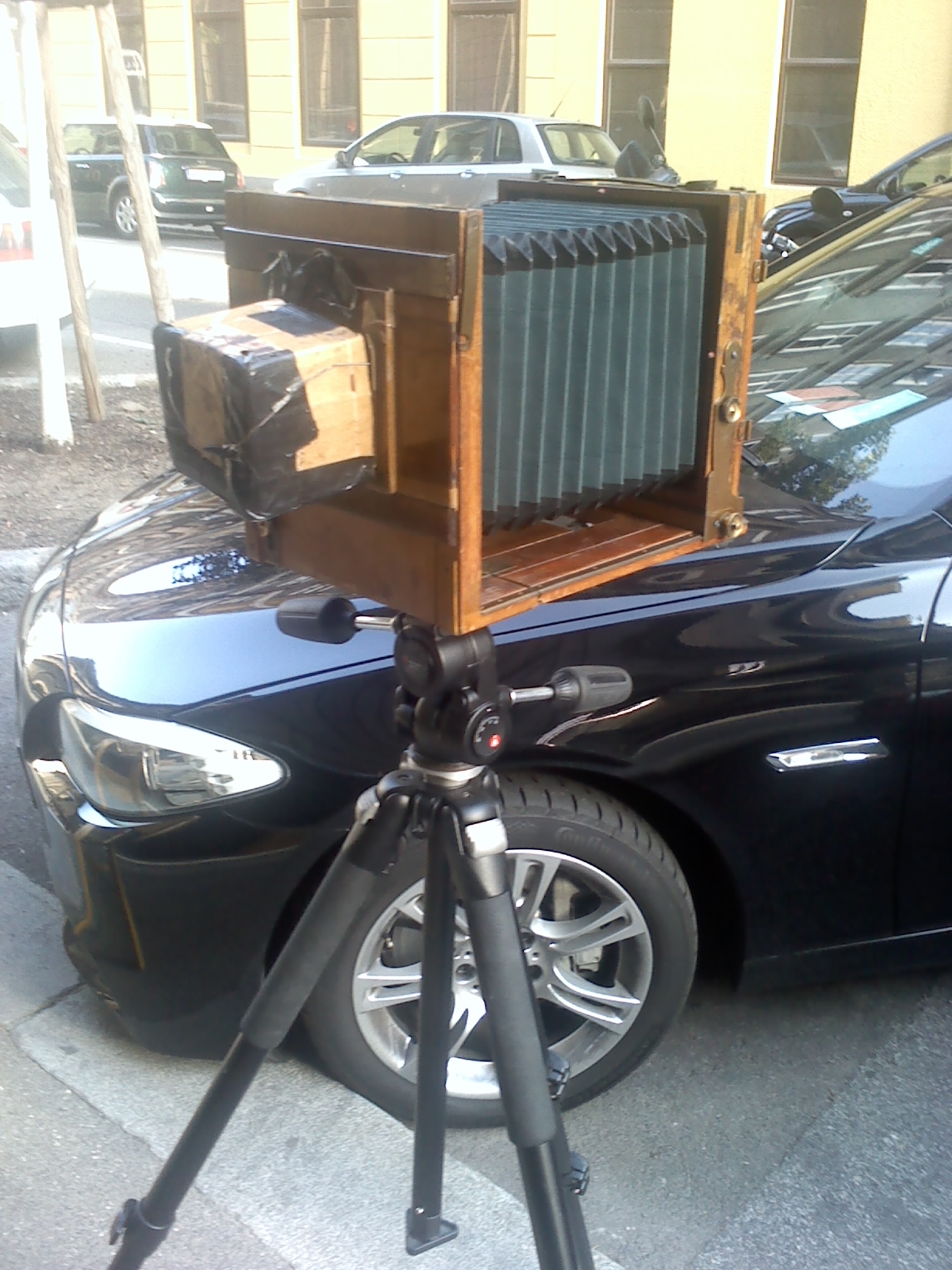
Agnes uses an antique camera. I thought it would be neat to take pictures of her for this blog post with my daughter’s Polaroid camera for double retro-technology points, but I couldn’t get the Polaroid to work ( you have to push the button repeatedly, it turns out) so I took these photos here with my smartphone, which gets irony points instead.

Agnes’ camera is the real deal – you sit there in the sun trying not to perspire in a borrowed sweater while she (under the black sheet, to keep the light out so she can see the image) focuses on a frosted glass plate in the camera. Then she goes into the darkroom, puts emulsion onto a metal plate (like most wetplate photographers, she gets her aluminum plates from a trophy supplies company in the United States) (some use glass plates, but they are fussier and of course fragile) which takes about 5 or ten minutes, then carries it back to the camera in a plate holder. The plate holder trades places with the frosted glass focus thing and the camera is ready to go.

The camera is very simple, and has no shutter. There is a lens cover (Agnes uses a cardboard box) which is removed to take the picture and put back to stop the exposure. That day, in the bright sun, Agnes used an exposure time of 10-15 seconds. Then she took the plate holder back out of the camera, and ran back to her darkroom to develop it. That took about ten minutes.

In other words, it takes about twenty minutes per photo. The plate must be exposed and developed while wet, so it can be kind of a rush depending on temperature.
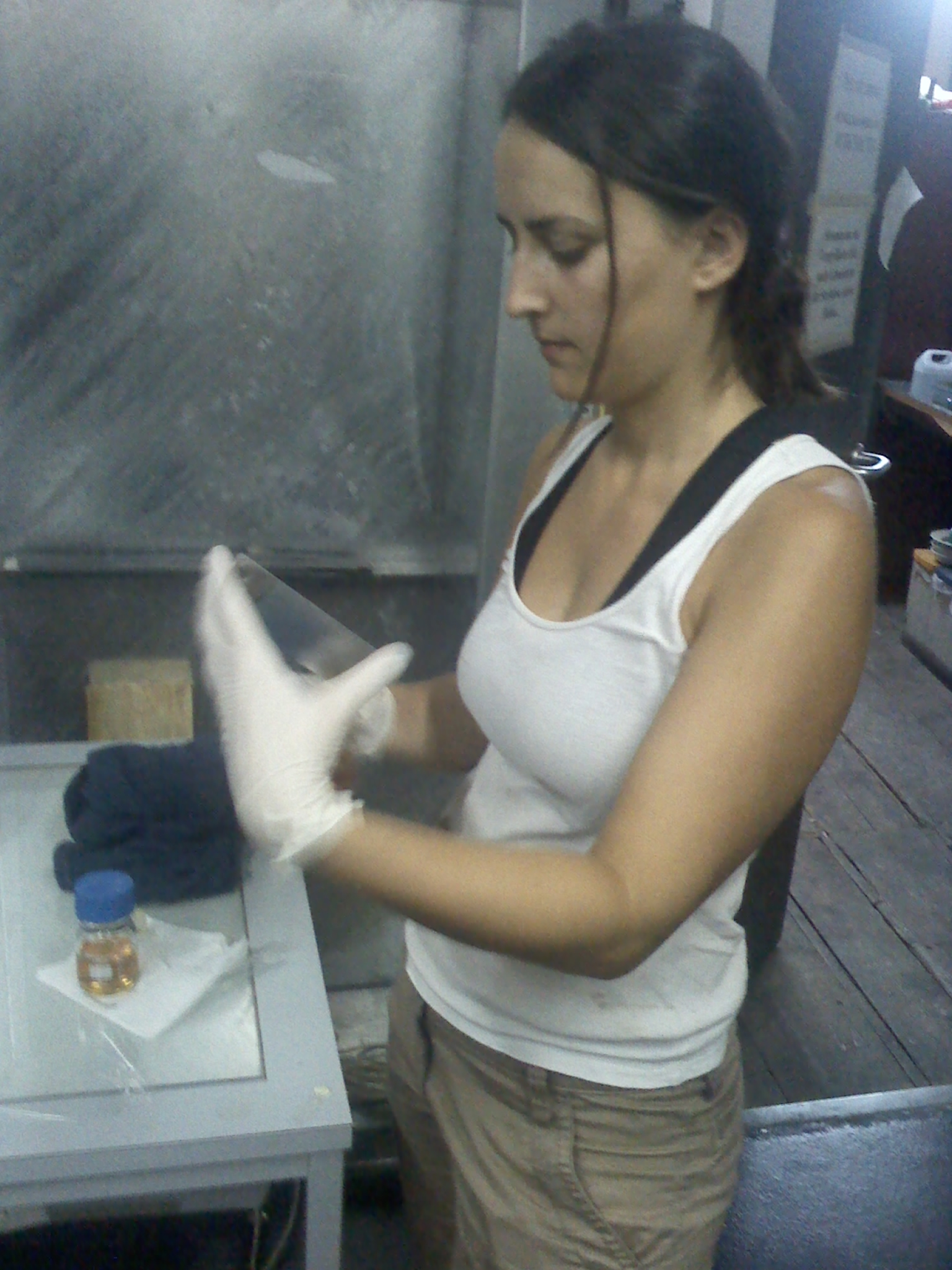
Agnes Prammer in her darkroom.

Agnes wasn’t really happy with the first picture so we did it again.

Wet-plate cameras are great ice breakers. While Agnes was back in her darkroom getting the next plate ready, everyone who walked past asked me about it.

I couldn’t tell them much, sorry.

Agnes doesn’t always use her darkroom. Like many wet-plate photographers, she has a portable field darkroom. I am kicking myself for not taking a picture of it, because it is awesome. She made it out of a baby carriage.

Agnes eventually came back out and got set up again. While she was getting set up, Roland Neuwirth walked past on the other side of the street. I am a big fan of his, but I ignored him because he is over sixty and has a bigger beard than I do, and I feared if Agnes noticed him she would kick me to the curb.

The second photo turned out better and we were done. Agnes gave me a tour of her darkroom and let me watch her develop the plate. This is how it works: collodion is a solution containing ether. It is poured over the plate to get an even film; when the ether evaporates, it leaves a tacky transparent film (it is also used in medicine to cover wounds). The plate is then placed in a silver nitrate bath. This is why Agnes is wearing gloves in the darkroom photo. Back in the day, wet-plate photographers were known by their black fingers. Then the plate is put into a plate holder, and exposed in the camera, and developed, all while still wet.

In a way, it is a form of instant photography, if you consider 10-20 minutes instant. And in fact, it still survives (more or less, in a relatively similar form, anyway) as instant street photography in the Afghan box camera (AKA kamra-e-faoree) in Afghanistan.

What I am not sure of is whether wet plate photography is resurging, thanks to Civil War re-enactors and antique technology buffs, or if it only seems that way to me because I am googling it and finding tons of information and projects. Maybe it was there all along.

Here is a Wired article on John Coffer, who has been doing wet plate photography for years now. He eschews the automobile and travels by horse, and lives in a house with no electricity or running water. Here is his website.

The technology is interesting because it is so simple. There is no shutter – it is basically a camera obscura, as my daughter Gamma says. If you can get a lens, you could theoretically make one yourself. Ian Ruhter made one out of a van to make impressive large-format tin types. You make each plate yourself, with chemicals that will get you high (ether) or kill you (some techniques use cyanide). This is another reason it is a good outdoor activity. At the same time, the results are superior to modern film photography, because (Agnes tells me) there is no grain because it is a liquid emulsion.

There will be a workshop next spring and I can’t wait to go.
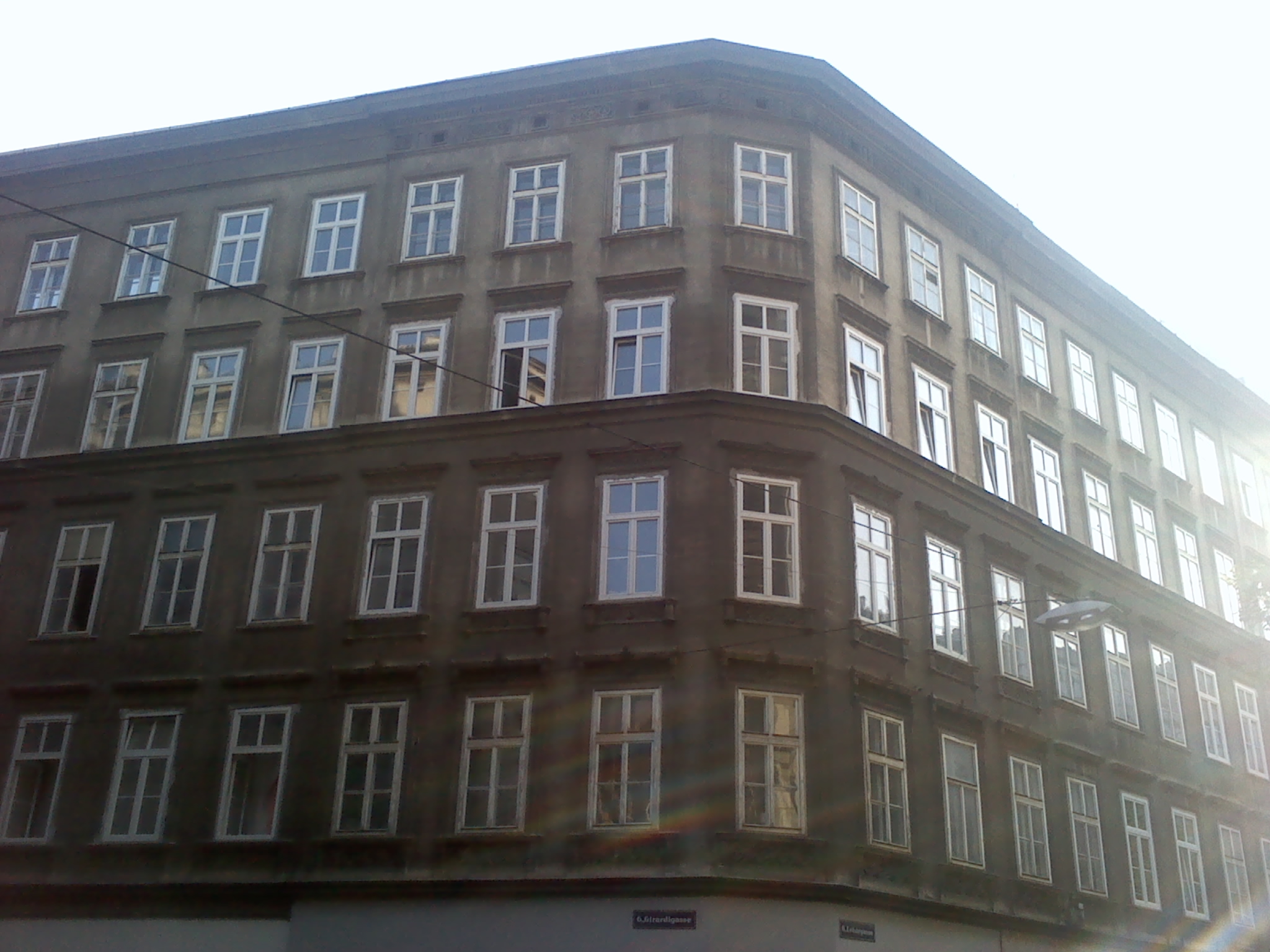
One must hold still for about 15 seconds, depending on the light, and focus one's eyes on a single point when being photographed this way, so I stared at one of the windows in this building across the street.
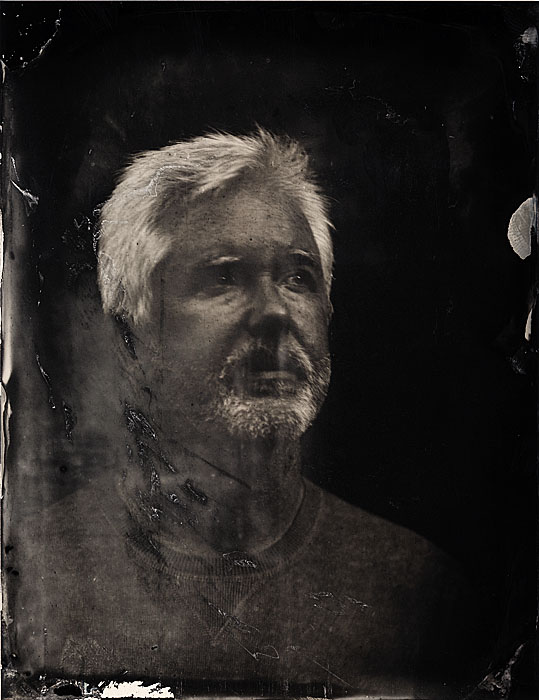
One of the photos Agnes Prammer took of me.

Shrimpbox wakes from ghostlihood

Sometimes he wakes deep in the night, old Shrimpbox, and wonders what noise woke him, but the only sound is his tinitus blaring and he wonders, did my tinitus truly wake me up just now? Will it just get worse and worse until I die?

Already, he reminds himself of – or he has entirely become – his father, shut off from those he loves by his deafness, close by but behind a wall.

When he’s alone in the house, wife away on business, kid on a field trip or something, he realizes it’s not solitude he wants. He wants his loved ones near, just in the other room.

He wants to be a ghost.

Does he want to be a ghost?

It’s what his father wanted. And when his father died, halfway around the world, Shrimpbox was playing dice with his daughters at home, rolling handfulls of dice on green felt. The dice all stood on their corners, balanced there, throw after throw.

Never have  since.

His father was an actual ghost. His father visited upon his death and made the dice stand on their corners. For Shrimpbox this is an unassailable fact.

Shrimpbox sits this morning and drinks his coffee and writes into a journal and looks around his room at paintings on the wall, by himself or given to him by friends. A glass of quills, electronics, tools, instruments, obituaries and postcards. He listens to the sounds of morning rising – the central heating coming on with its hum of warmth, the bell-like hiss of the radiators, footsteps two floors up, plumbing doing its thing, and drowning it all out, tinitus and the scratching of his pen.

If all a ghost can do is balance dice upon their corners, he has been insufficiently rewarded for spending a lifetime hiding in another room. Not even if you could stand silent, Shrimpbox thinks, stand silent in the corner and watch them always at their happiness, those you love.

He shuts his journal and goes upstairs.

Toxoplasma gondii redux

Driving to town the DJ is talking about toxoplasma gondii on the radio.

Everything the DJ says, Shrimp Box says first.  Except, the DJ is getting it all wrong.

Mice, rats, Shrimp Box is yelling.

Often, while driving, you see people yelling in their cars and wonder what they’re so excited about.

Parasites! is the answer.

Their life cycle something something, they move from rats to cats and back. They mate in the cats’ intestines or something, he says.

According to the DJ, toxoplasma gondii is why people are extroverts.

Shrimp Box doesn’t know about that.

He’s oversimplifying, he says to his daughter.

Also, I said toxoplasma gondii is my favorite parasite, but it might be cordyceps, when I think about it.

Also, 22% of Americans are infected? So what? There’s a town in the Czech Republic with a way higher rate of infection, he says.

Yells.

And it doesn’t just make you extroverted. It has different effects on men and women. Men it makes paranoid or something. Women warm and social or something. But it makes everyone take risks. Just look at the rats and mice, they run up to cats and stuff and get eaten. They examined motorcyclists who’d been in accidents, and they had a higher rate of infection than the general population.

I had four cups of coffee this morning, how many did you have, he yells.

This is called getting the day off to a good start, he yells.

And nary a garbage truck nor student driver was seen that morning as Shrimp Box made his appointed rounds, and at work someone gave him a snack made of beans that had been exposed to gamma radiation or something.

What do we say to death? yells Shrimp Box. We say, not today!

Best-selling metamorphosism blog book progress report

Have completed initial rough editing  (i.e. cutting code-like stuff and hopeless posts) from 1865-2006. Bugging me how many posts got truncated in moves/exports/migrations/??? Without fail, if there is a comment such as, “That last paragraph was the best thing you ever wrote,” the last paragraph is missing.

It’s all gravy after that

Yesterday morning, I watched as a hipster gracefully rode a bicycle into a revolving door, then got stuck halfway around. That alone was sufficient compensation for getting out of bed that morning. The rest of the day was pure profit.

Some days are like that, the payoff comes early.

Some days, it takes until just before bed, maybe your kid shows you what she did in psychology class, classical temperament types. You’re melancholic, she says. Mom’s choleric. I’m phlegmatic.

There are days, of course, when getting out of bed is a mistake. But you never know.

Lately, though, they’ve been good. A tortoise sniffing the draft coming in under the door even before you make coffee in the morning (it’s cold nights lately, the tortoise has to stay in the house until he goes into hibernation).

A cat trying to talk you out of bacon.

Meeting a nice person.

Seeing your kid happy, or your wife.

Take the stairs to the shrimp box

Shrimp box is in a much better mood now that the kid is home from Hungary. The rains have started, cold rains that make the doorbell hum until it catches fire, so he took it apart preemptively, feeling a little like a bomb squad guy; and the gray cat has disappeared, and his wife (Shrimp box’s wife) is still in Japan, and his other daughter is in Vienna living her life, but the kid is home. He makes fruit salad for breakfast, honey dew melon and peach, and the kid eats some cereal too because she had missed cereal in Hungary, where her family stuffed her with everything else but cereal.

Shrimp box is glad to have meaning in his life again.

He wonders about the tortoise, and will it have to come inside now that it is getting colder and wetter.

Shrimp box listens to a video on Vimeo while taking a shower. He wanted drone music, but it turns out to be more metallic, and only by a band called Drone. Oh well. It sounds as if the vocalist is hollering ‘take the stairs to the shrimp box’ and Shrimp box decides to change his name to Shrimp box and to write a song with absurd lyrics, since he never understands song lyrics anyway.

The kid is so happy to have access to coffee again. Apparently Hungarian children do not drink it. She talks a lot in the car on the way to town.

‘I was reading old blog posts,’ Shrimp box says. ‘When I came home from America after going to my father’s funeral, you said, Boy am I glad you’re home, I forgot what you looked like. I only remembered that you had white hair, and that you’re nice.’

‘I said that?’ the kid is bemused.

The rain gradually peters out and stops entirely during their drive into town.

Hello, green grasshopper

We had a big green grasshopper in the living room a couple nights ago. Naturally it kept jumping on Gamma, who currently has what I imagine is a temporary case of acridophobia, the fear of having big green grasshoppers jumping on you. I caught him with a dish and a  newspaper (directions: while grasshopper is distracted reading the paper, put the dish over him) and put him into the hanging basket outside.

The following day, I was going to the kids’ apartment in Vienna after work to pick up Gamma to give her a ride home when I noticed a green grasshopper on the dashboard. It was a different one, I think. It looked smaller.

Hello, green grasshopper, I said.

I hoped it wouldn’t jump into my face while I drove and cause an accident.

I decided I would catch it when I got to the apartment and put it in a plant.

But it was so quiet I forgot it was there. Also I distracted myself thinking about how, in the 1980s, my first decade of adulthood, I thought everyone was crazy who bought the idea that deregulating anything was a good idea and how the past 30 years have proven me right and regulations were put in place for a reason and why not just take mean dogs off their leashes and take off their muzzles and say, go for it, dogs? Time to put a little more trickle in the trickle down.

So my mind was not on grasshoppers when I got where I was going.

Also I was thinking about how blogging is dead, personal blogging like this, I mean, now that everyone is on facebook, only you can’t write the way I write here on facebook, at least I can’t.

I got Gamma and we were driving along and something green flew past and Gamma was all, eek! And I was all, what? And she was all, IT’S ON YOU! and I was all, what? And she was all, green! Green grasshopper! And I was all, oh, right.

It was on my shoulder so I rolled down the window and threw it out (we were at a light) and it flew into some trees.

In the direction of the trees, at least. Up, for example.

Little green grasshopper.