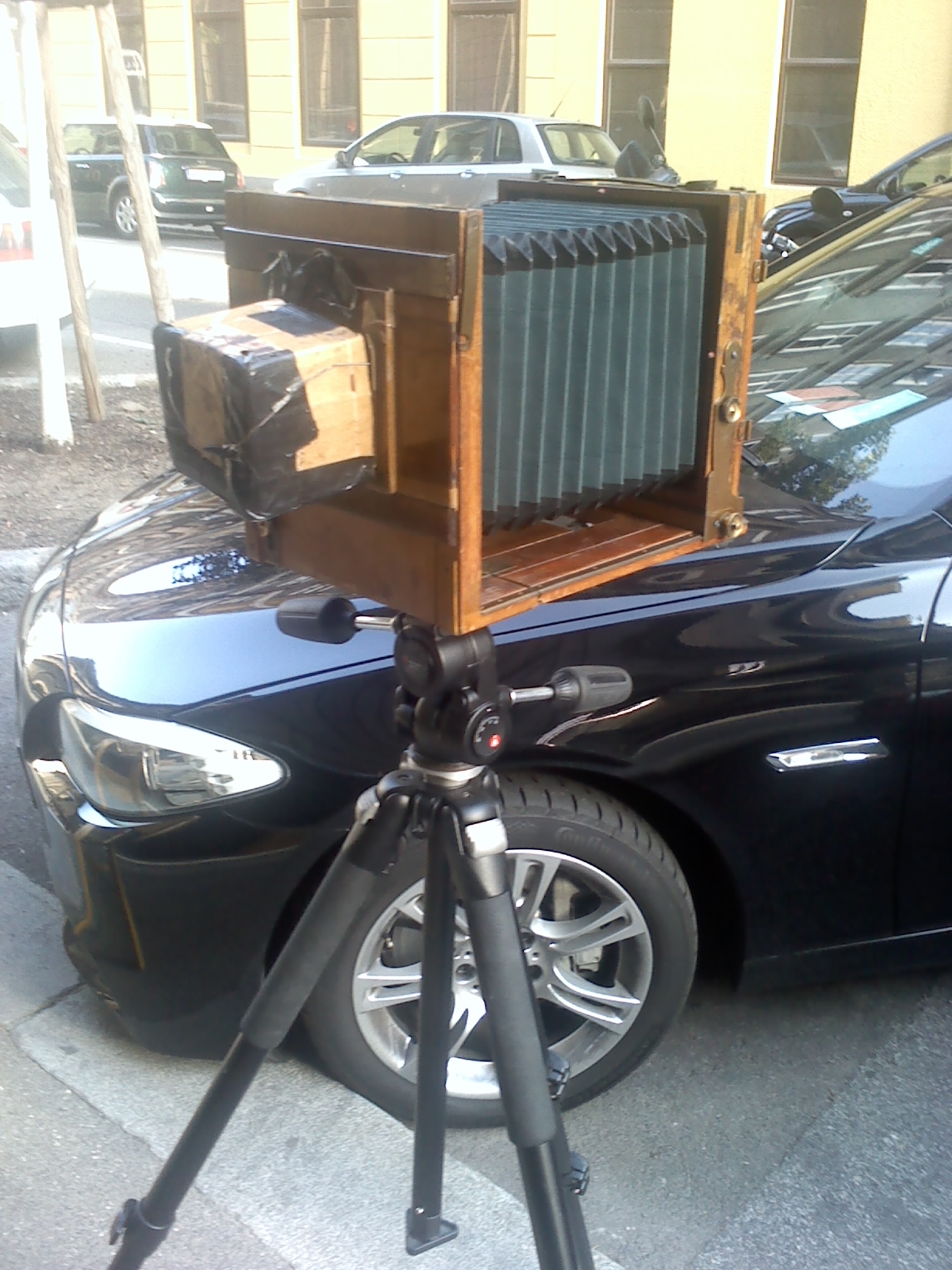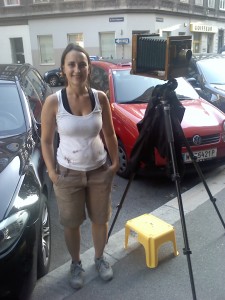
Vienna collodion wet-plate photographer Agnes Prammer with her camera.
This is Agnes Prammer with her collodion wet-plate camera.
It started this summer. I read an ad online looking for models. Men over 60 with beards, and pregnant women.
I thought that sounded like an interesting combination, and in my optimism (I met 2 of the 5 requirements, being a man with a beard) contacted the photographer.
And that is how I found myself…
…wait, I also wanted to insert somewhere towards the start, ‘earlier that summer my family and I were wandering around Vienna late at night and looked inside this one large building full of… stuff, and pillars, and mysterious light, and I thought at the time how full of surprises and interesting architecture Vienna is and what kind of life must that be that has one frequenting such buildings?’
Done.
So I contacted the photographer and she said sure, she’d take my picture for her project, and I programmed the address into my GPS and drove there.
The first interesting detail in this interesting story is the fact that the address does not exist. The proper address is number 6, and the GPS took me to the right place, but the number over the door is an 8. Mysterious, right? Also it turned out to be the mysterious building we had seen earlier in the summer, the studios of the academy of fine arts.
Luckily the photographer was waiting for me outside, which is proper etiquette when your address is imaginary.
The photographer’s name is Agnes Prammer. She does collodion wet-plate photography, which to my understanding is the (American) Civil War-era process that produces negative images onto glass or metal plates using a liquid emulsion. Tin type photos are one example of this, I guess. Agnes became interested in collodion wet-plate photography while in the United States, where the technology has been revived (or popularized) by Civil War re-enactors, among other people.
She explained her project to me, I changed into a sweater she wanted me to wear for the photo, and she took me to her studio, which was a stool on the sidewalk outside the academy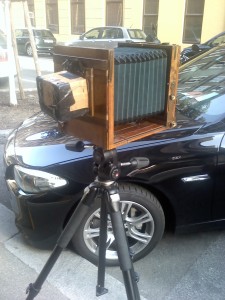 , with a black backdrop. Wet-plate photography requires long exposure times so usually is done outside in natural light.
Agnes uses an antique camera. I thought it would be neat to take pictures of her for this blog post with my daughter’s Polaroid camera for double retro-technology points, but I couldn’t get the Polaroid to work ( you have to push the button repeatedly, it turns out) so I took these photos here with my smartphone, which gets irony points instead.
Agnes’ camera is the real deal – you sit there in the sun trying not to perspire in a borrowed sweater while she (under the black sheet, to keep the light out so she can see the image) focuses on a frosted glass plate in the camera. Then she goes into the darkroom, puts emulsion onto a metal plate (like most wetplate photographers, she gets her aluminum plates from a trophy supplies company in the United States) (some use glass plates, but they are fussier and of course fragile) which takes about 5 or ten minutes, then carries it back to the camera in a plate holder. The plate holder trades places with the frosted glass focus thing and the camera is ready to go.
The camera is very simple, and has no shutter. There is a lens cover (Agnes uses a cardboard box) which is removed to take the picture and put back to stop the exposure. That day, in the bright sun, Agnes used an exposure time of 10-15 seconds. Then she took the plate holder back out of the camera, and ran back to her darkroom to develop it. That took about ten minutes.
In other words, it takes about twenty minutes per photo. The plate must be exposed and developed while wet, so it can be kind of a rush depending on temperature.
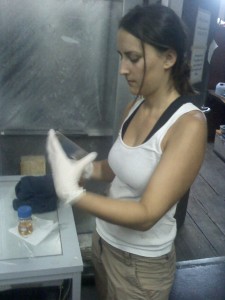
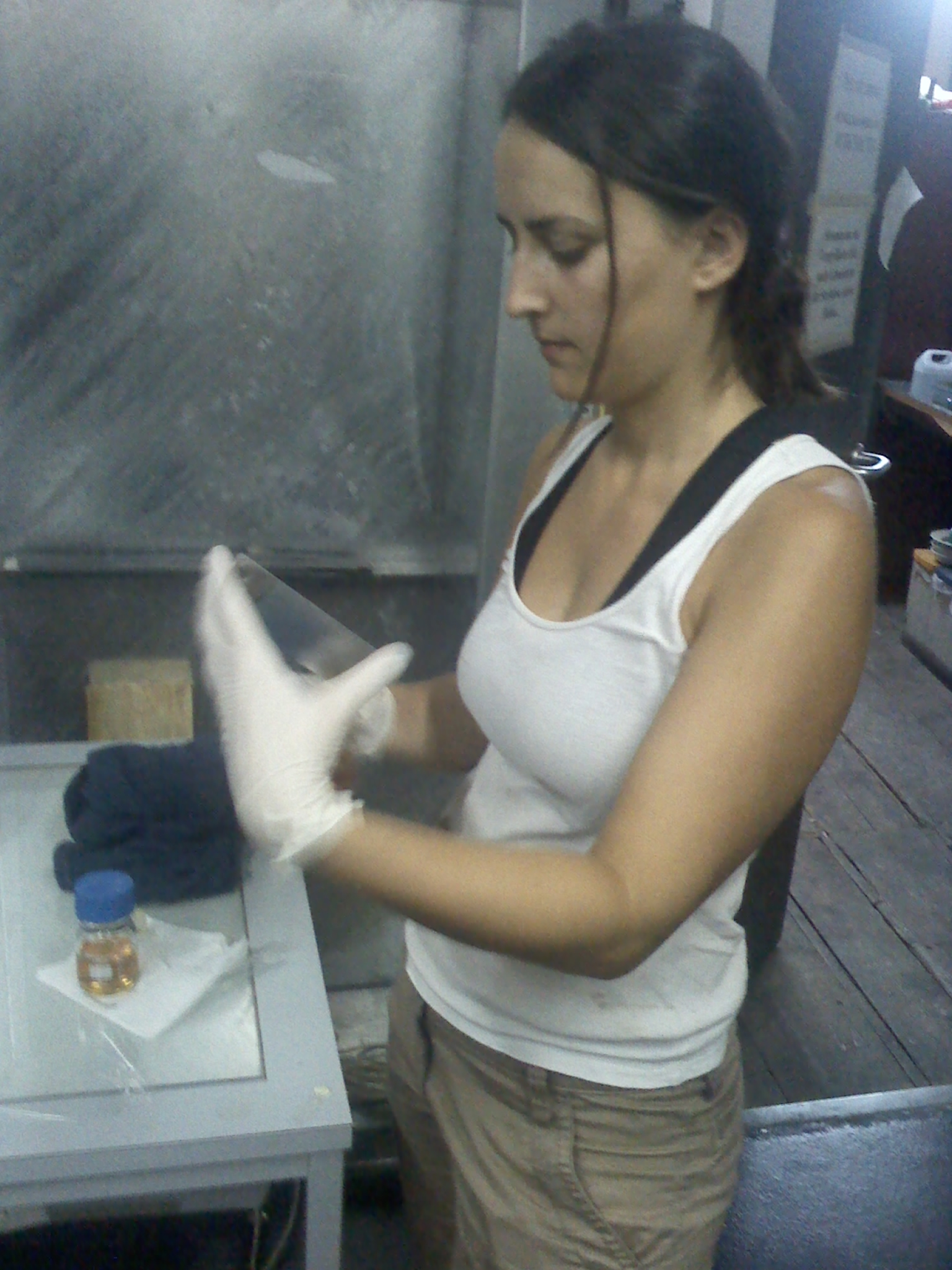
Agnes Prammer in her darkroom.
Agnes wasn’t really happy with the first picture so we did it again.
Wet-plate cameras are great ice breakers. While Agnes was back in her darkroom getting the next plate ready, everyone who walked past asked me about it.
I couldn’t tell them much, sorry.
Agnes doesn’t always use her darkroom. Like many wet-plate photographers, she has a portable field darkroom. I am kicking myself for not taking a picture of it, because it is awesome. She made it out of a baby carriage.
Agnes eventually came back out and got set up again. While she was getting set up, Roland Neuwirth walked past on the other side of the street. I am a big fan of his, but I ignored him because he is over sixty and has a bigger beard than I do, and I feared if Agnes noticed him she would kick me to the curb.
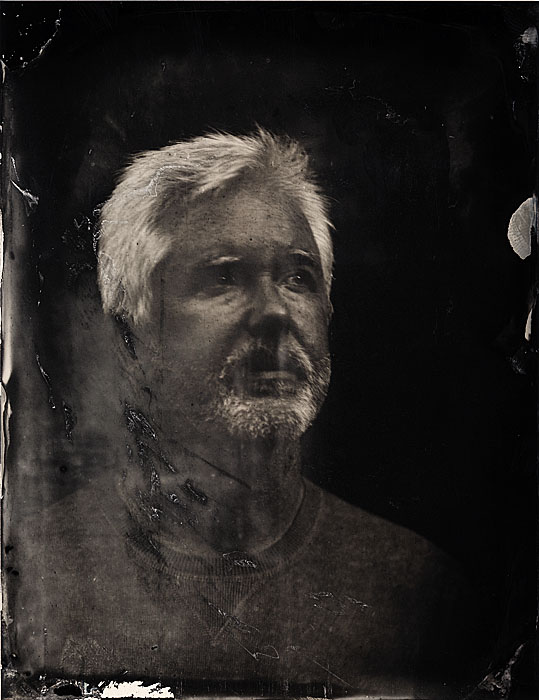
The second photo turned out better and we were done. Agnes gave me a tour of her darkroom and let me watch her develop the plate. This is how it works: collodion is a solution containing ether. It is poured over the plate to get an even film; when the ether evaporates, it leaves a tacky transparent film (it is also used in medicine to cover wounds). The plate is then placed in a silver nitrate bath. This is why Agnes is wearing gloves in the darkroom photo. Back in the day, wet-plate photographers were known by their black fingers. Then the plate is put into a plate holder, and exposed in the camera, and developed, all while still wet.
In a way, it is a form of instant photography, if you consider 10-20 minutes instant. And in fact, it still survives (more or less, in a relatively similar form, anyway) as instant street photography in the Afghan box camera (AKA kamra-e-faoree) in Afghanistan.
What I am not sure of is whether wet plate photography is resurging, thanks to Civil War re-enactors and antique technology buffs, or if it only seems that way to me because I am googling it and finding tons of information and projects. Maybe it was there all along.
Here is a Wired article on John Coffer, who has been doing wet plate photography for years now. He eschews the automobile and travels by horse, and lives in a house with no electricity or running water. Here is his website.
The technology is interesting because it is so simple. There is no shutter – it is basically a camera obscura, as my daughter Gamma says. If you can get a lens, you could theoretically make one yourself. Ian Ruhter made one out of a van to make impressive large-format tin types. You make each plate yourself, with chemicals that will get you high (ether) or kill you (some techniques use cyanide). This is another reason it is a good outdoor activity. At the same time, the results are superior to modern film photography, because (Agnes tells me) there is no grain because it is a liquid emulsion.
There will be a workshop next spring and I can’t wait to go.
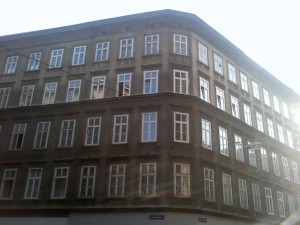
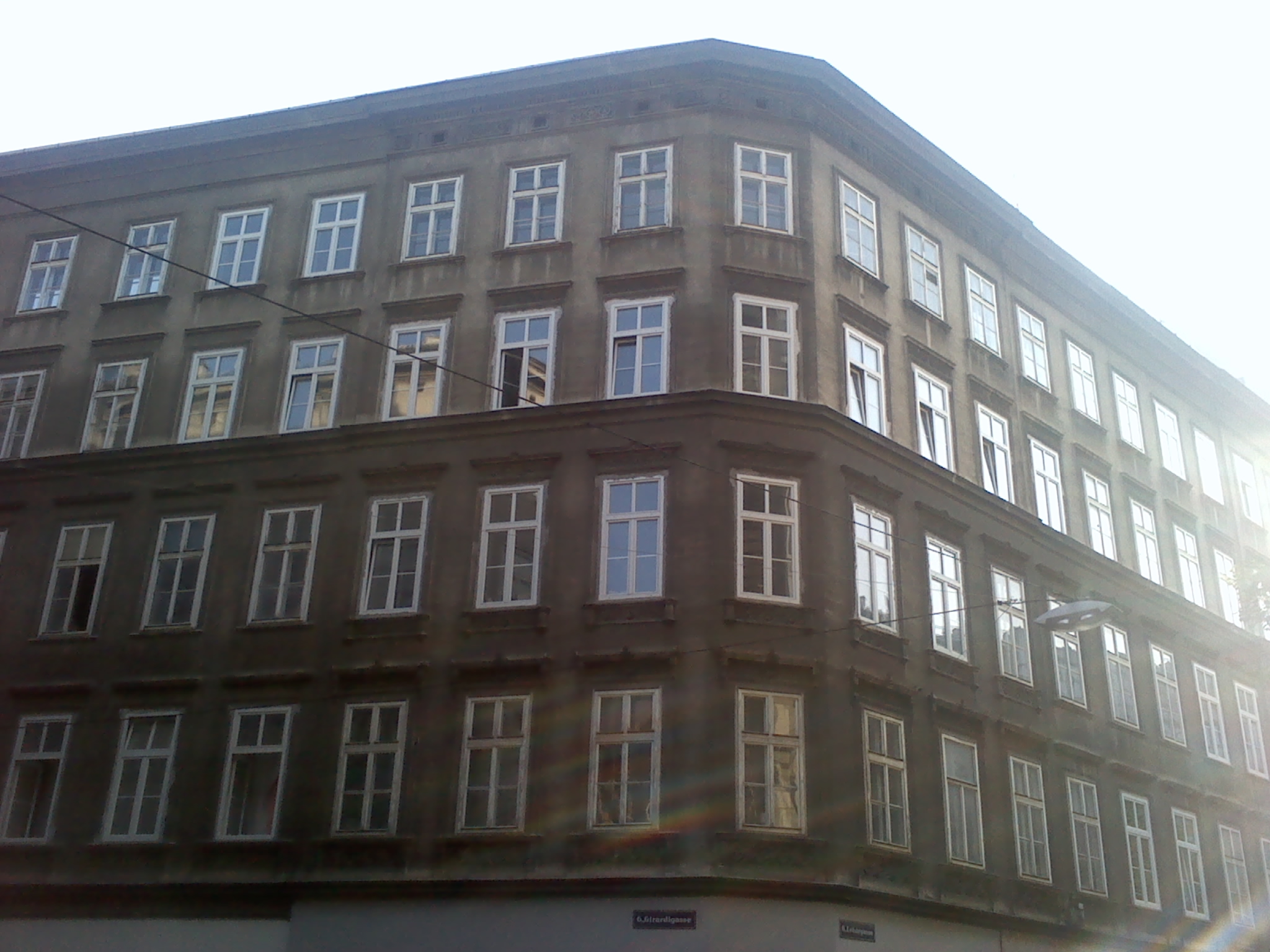
One must hold still for about 15 seconds, depending on the light, and focus one's eyes on a single point when being photographed this way, so I stared at one of the windows in this building across the street.
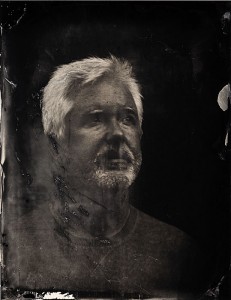
One of the photos Agnes Prammer took of me.