Ginsberg’s first poem discovered

    Literary researchers at Evco University today released what they say is Allen Ginsberg’s first poetic work, written for his school’s Groundhog Day poetry contest when he was in second grade:

I saw the best groundhogs of my generation destroyed by
madness, gawking newsmen hysterical children
dragging themselves through the mouth of their burrow at dawn
looking for an angry sun,

Continue reading

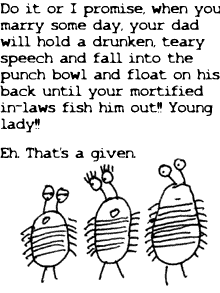
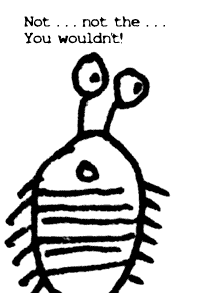
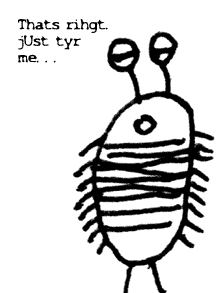
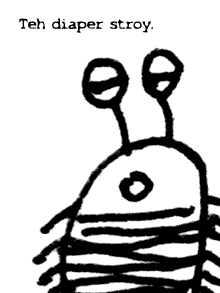
The Art of Parenting

bug77-1.gif bug77-2.gif bug77-3.gif bug77-4.gif bug77-5.gif bug77-6.gif bug77-7.gif bug77-8.gif

Originally posted March 2004

Posted in The Bug

Permalink

Crane theory of aesthetics

In my dream, I was looking for a wine that went well with bacon. It had to be a white.

Later in the morning, after waking and stuff, on our drive into Vienna, I said I missed the sunrises in the morning and Beta said, Actually, we had a sunrise this morning, we just didn’t notice it.

That was because we were busy taking Gamma’s lunch for a ride.

Monday, it was Monday. We got out of the house a little too late to arrive in Vienna on time for Beta to easily make the bus she needed to catch for her school outing but, eh, if we hurried. Except I had to run the cello by the music school cause I have cello Monday evenings. We were almost to the school when Alpha called and said Beta had taken Gamma’s lunch.

Due to a complex constellation of reasons, we decided to return home with the lunch rather than tell Alpha to make another. This precluded bringing the cello by the music school then. So Monday was take-your-cello-to-work day.

Beta made her bus in plenty of time. I got all apocaplectic for nothing.

Tuesday I drove into town alone, as Beta was still on her school outing. I missed Beta. I ended up using the time to think about my construction-crane-based theory of aesthetics.

I drive past a bunch of them on my way to work, you see. Construction cranes. Theories of aesthetics too, probably, only they’re not so obvious.

There’s nothing like a construction crane, is there? Most elegant human invention ever. I could watch them all day, only in traffic that’s dangerous. Today, I drove by a group of three, and one was even moving, swinging around about 180 degrees. It was great.

If you can see things the way birds must see them, for example, or in some other fresh way, so many ugly things are beautiful. Power lines, what a great place to sit and rest your wings.

Felled trees. They’re currently doing a lot of logging where I drive. I used to feel bad for the trees. I still do, but I also think: boy, no nicer smell, and face it, there’s something beautiful about felled trees too if you can only admit it. I’m not saying we should go out and cut down trees. I’m only saying.

If you can open up to it, there’s a lot out there.
Valentine’s Day Limerick Contest

heart01.jpgheart02.jpg
Time for the annual Metamorphosism Valentine’s Day Limerick Contest.
Entries should be made in the comments to this post.
Winners will be announced on 14 February, 2007.
ENTER AS OFTEN AS YOU LIKE!!! Extra points for productivity!!!

Rules:

  1. Poems entered must be a freaking limerick. We are getting stricter about this every year.

  2. Entries must have, as a theme, some aspect of human attraction.
  3. Extra points awarded for working in one of the following: hereditary disease, Celtic deity, automobile brand/model (real or fictional), a truss
  4. Rules subject to change without warning (changes will be posted here or in a subsequent post)

(Note: Over the years, a number of rude etc expressions have been added to the comment blacklist so if the comments refuse your entry that might be the reason. In that case, mail it to me at metamorphosist (at) gmail dot c0m and I’ll set you up.)

Last year’s contest here + winners announced here

A horse walks into a bar

“I thought you were dead,” I murmured.
“Very funny,” he snarled.
“Thanks,” I sneered.
“Listen, you should know about this. I just can’t stop thinking about perseveration lately,” I verbalized.
“Hah!” he ejaculated.
The bartender threw us a rag. “You guys are cleaning that up yourselves.” It was Susan Sontag.
“I thought you were dead,” I mumbled.
I pushed the rag across the table to the horse.
“And another thing,” Susan Sontag said. “From now on, just say, ‘he said’.”
“Okay,” we said, nodding like bobblehead dolls cause, you know: Susan Sontag.
“Perseveration as opposed to perseverance,” I said.
The horse nodded sagely. “Tell me about it,” he said.
“I’ve just been wondering about the positive and negative aspects of sticking to something. There is the don’t give up and there is the know when to quit, you know?” I said.
“There is being insistent and there is taking No for an answer. There is romantic pursuit and there is stalking. There is the 1% inspiration and the 99% perspiration, and there is the 100% perspiration,” he said. “There is the sound of one hand clapping, and there is the sound of a head against a wall.”
“Huh?” I said.
“Forget the last one,” he said. “There is the definition of insanity as doing the same thing and expecting different results, and there is keeping your nose to the grindstone.”
“What I’ve been thinking about, specifically,” I said, “and yet in general terms, is the experience of analyzing a situation in which one finds oneself, concluding that it is suboptimal and then what?”
“You mean, you are in this situation and it’s, this is bad. Either it’s not working for me, in which case I must try something new, or it IS working for me, in which case, why do I want something bad?”
“Exactly,” I said.
“But there’s no point in beating up on yourself for fearing change. In fact, the beating up is a substitute for trying a different approach.”
“What I think is, if one’s trapped in a cycle of stasis or procrastination, one might be able to trick oneself out of it with small changes in method. Attacking smaller tasks one at a time, regularly, instead of looking at the gigantic ball of dung one is hoping to roll back up the hill.”
“Kate Bush, right?” Susan Sontag said. “You guys going to order anything?”
“We’ll have the usual,” I said.
The horse nodded.

Nie wieder Grieg

A cellist1 and a violinist2 are in the same amateur orchestra. They are sitting at a kitchen table, talking shop.
Cellist: You going to the rehearsal this afternoon?
Violinist: Uh-huh.
Cellist: You have the songs down already?
Violinist: Ehn.
Cellist: How’s the Mozart?
Violinist: I can sort of play it.
Cellist: The Mozart is okay at half speed. Full speed it still throws me. What about the Grieg?
Violinist: Nuh-uh. Not at all.
Cellist: That’s a relief. Me neither. I have a total mental block on the Grieg.

Continue reading

How to be

I wanted to take a relaxing bath and read in the tub, but I couldn’t find anything I wanted to read. So I lay on the bed trying to decide what I would do in the tub instead. I decided I would just lie there. Then I realized that I was already doing that on the bed, and that it would be easier to just remain on the bed, since I was already doing what I would be doing in the tub, rather than getting undressed, drawing a bath, climbing in, climbing back out, drying off, and getting dressed.

So I just stayed there on the bed. It turned out to be nearly as relaxing as the bath, and a lot less effort.

I got all these inspiring thoughts. I thought, first of all, “If I didn’t have this pin through my thorax and if I were not dead, I would fly away.” Almost immediately, I could hear my father and everyone else in his position reminding that there is dead and there is dead, and we must use the two words carefully and not mix them up.

And I thought, where I come from rainbows are black and have pots of tar at their ends. I could envision a book of aphorisms like that, illustrated by a child. Postcards, maybe.

And then I had this brilliant thought: If it is so hard being who you are, pick something easier and work your way back up. The trick is to find a you that requires a minimum of effort for you. Different people will require different energy levels for different selves. It’s not a one-size-fits-all thing. A certain existence might be easy for one person, hard for another. The result is that almost everyone is someone else, which is more interesting than if everyone were the same person.

Some people are who they are seemingly without effort, imbued with grace. Others, however, have personas and selves and so on which appear to require great effort, maybe even more energy than they have available, resulting in feelings of failure, insufficiency and exhaustion.

The mistake is in taking on these difficult selves too soon. They must be trained for, like a marathon or weightlifting.

The trick is to pick something easier and work your way back up. If you find it hard being lonely and unhappy, try being happy first. Lonely and happy, for example. If that’s still too hard, be happy and popular. How hard can that be? Then when you get used to that, crank it up a notch and try popular and unhappy, or happy and lonely. Then when that’s working for you, go back to lonely and unhappy and you’ll be amazed at the difference.

The trick is to do it in steps.